
How to Come Up With Video Ideas: Talk First, Build Second
October 23, 2026
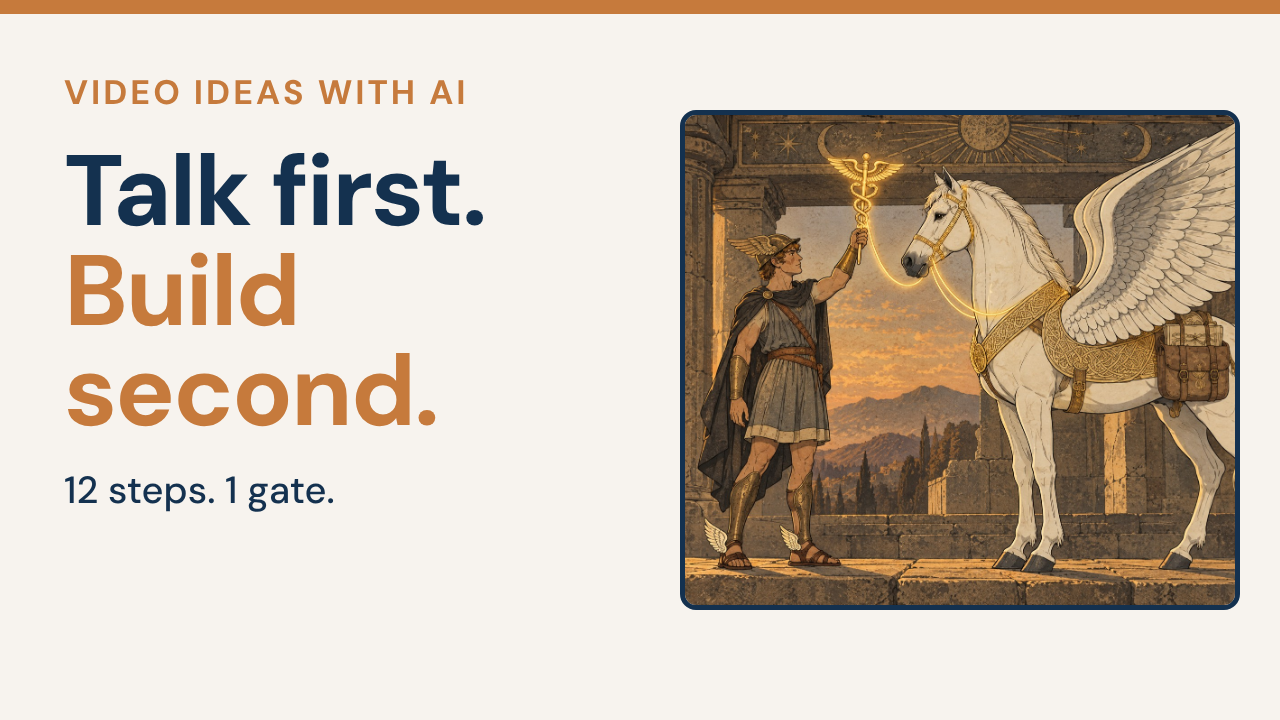
This is the video behind the post. It shows the 12 steps on a real film I made in 1 evening, including the mistake my checks missed.
Here’s how to come up with video ideas with AI. Talk first, then build. Spend 7 steps getting to 1 sentence and a twist that’s yours. Then say 1 word, approved, before the AI makes anything.
Under 15 minutes of talking turned into a 29-second film. Then I went to bed, and my AI built the first version in 18 minutes.
The film isn’t the point. The point is how the idea showed up.
Why your AI keeps building too early
My friend Jordan asked me how I make my videos. I couldn’t explain it, so I talked it through with Claude. Claude is an AI assistant that works right inside my folders.
Right away, it wanted to start building. I kept pushing back because I didn’t have the idea yet.
That back and forth turned out to be the first half of my method. There are 2 stages and 1 gate between them. You talk, you say approved, then you build.
An AI is like a framing crew. Great hands, but they still need the plans.
How to come up with video ideas: the 7 talk steps
1. Feed it. Start from something you keep coming back to. A world, a tool, someone else’s work, or a challenge. Mine was Jordan’s made-up world, starring Hermes, the Greek god of roads. (Step 1 in the video)
2. Say it in one breath. What you’re building and what it’s saying, in 1 sentence. Mine was “how powerful an agent with direction can be.”
3. Talk it through. I ask the AI for advice, like I would a friend. It’s not interviewing me. It’s sending out ideas to spark other ideas. Then I ask for the piece that’s missing. I asked for a creature from Greek mythology, and it came back with Pegasus and the myth of his golden bridle. (Step 3)
4. Catch the twist. That’s when it clicked. Pegasus is the AI, all that power. The bridle is my context, my folders, my instructions. The AI brought me the horse, but the link was mine. (Step 4)
5. Sleep on it, only if you’re stuck. A break helps after you’ve really worked a problem. A review of 117 studies found the same thing: stepping away helps, and it helps most on open-ended tasks like coming up with ideas (Sio and Ormerod, 2009). I wasn’t stuck, so I kept going.
6. Check it against the rules. Jordan’s world says Pegasus never wears a metal bit. So the bridle became golden light with no bit. The rules didn’t kill the idea. They made it better.
7. Plan it once. What happens, what gets said, and the last words on screen. The script is mined, not invented. The AI pulls it from my own words in the talk. My favourite line in the film came straight from what I’d said. (Step 7)
Most people stop talking too soon. Research on idea generation found people expect their ideas to dry up, but they keep coming if you stay with it (Kellogg School of Management).
The gate: 1 word
I change any line I want. Then I say 1 word. Approved.
Nothing gets built until I say it. That 1 rule is what keeps the AI from running off with a half-made idea.
It’s the same thinking as deciding what to build and what to buy before you spend a dollar. I wrote about that in build vs buy software.
The 5 build steps
After approved, the AI runs the build. I choose the look and the spending. The AI does the technical work.
8. Voice first. The voice sets the timing for everything else. Mine came from ElevenLabs, a tool that copies my voice.
9. 1 picture for every scene. Made in Higgsfield, an AI picture maker. Lock the pictures before any video. A picture is cheap to redo. A clip isn’t.
10. 1 thing per clip. Higgsfield turns each picture into a short clip that does 1 thing.
11. Put it together to match the voice. Every piece gets checked against the plan.
12. Test it, then watch it yourself. The AI ran 6 checks. Those are small test programs, and all 6 passed. Then I watched it, and I caught something they missed. (The mistake)
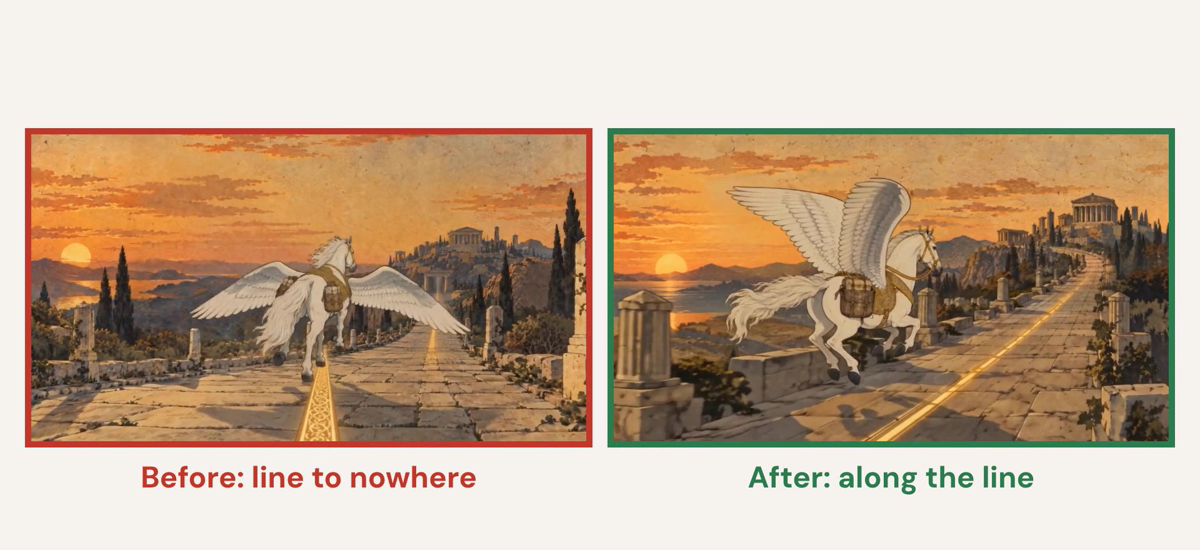
In shot 4 the glowing line pointed out to nowhere. So we went back to the first clip, where Pegasus runs right along it. Checks catch what you told them to look for. Your eyes catch the rest.
The 3 rules I took from this build
- Talk first, then ask for a plan, and approve it before anything gets built.
- You choose the look, and you control the spending.
- Turn every mistake you find into a new check. That way you have a better chance of catching it next time. (The rules)
The bridle is the part you own. Mine is a folder of rules for how I work, and my AI reads it before it starts. If you’ve seen how I set up a small business system, it’s the same idea. Or how I use Claude with Airtable to run the office side. And when the bridle is missing, you get the problem in why does AI make things up.
Try it on your next idea
The 12 steps, the prompt for each stage and a short page you can keep open are free in my Skool community. It’s called See It, Build It, Own It, and the lesson is 7.6 in Build Anything.
Pick 1 thing you want to make for your business. Talk until you have your 1 sentence and your twist. Then say approved.
The power was always there. The bridle is yours.