
Small Business Systems: Fix Your Office Work in 3 Steps
October 3, 2026
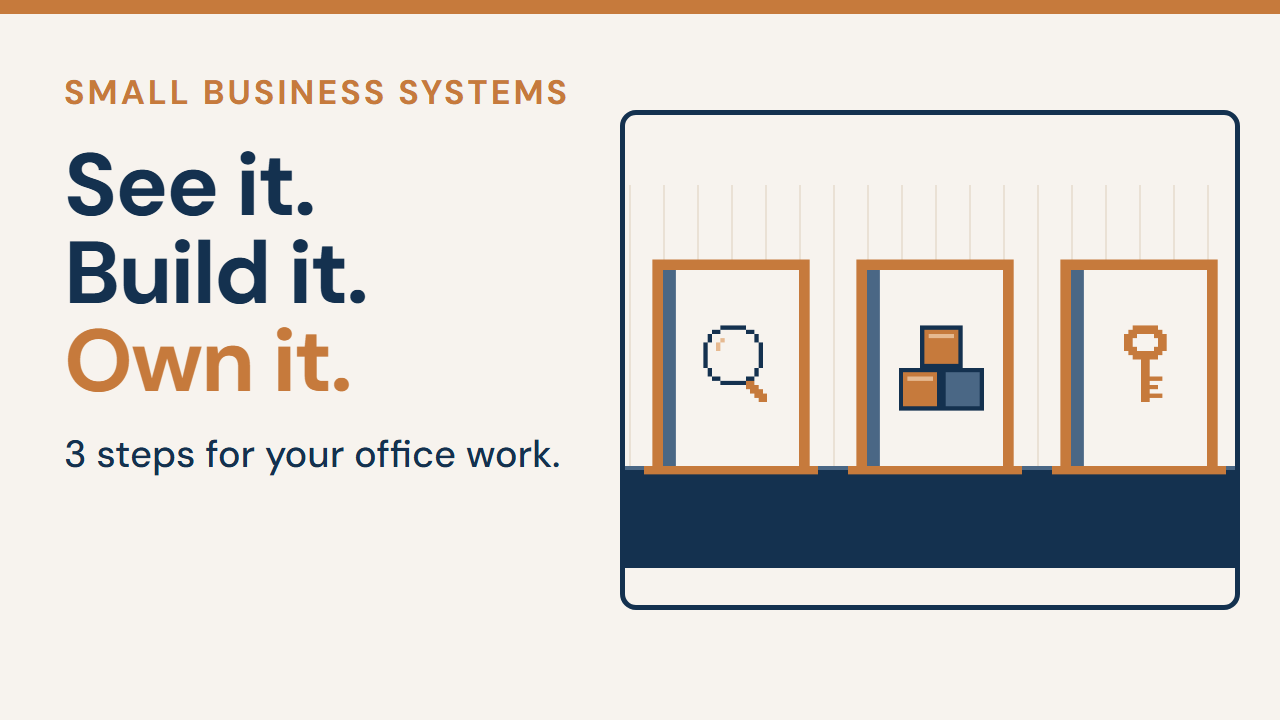
This is the video behind the post. It walks one electrical shop through all 3 steps, so you can see a small fix come out of something the owner already had.
Good small business systems start with 1 problem, not with a pile of new software. Name the 1 office problem costing you the most, pick 1 small fix your team can run, and stay in control of it.
That method is See it, Build it, Own it. If you’ve been asking how to organize a small business, this is where I’d start. The rest of this post is how to run it on your own office work.
Small business systems: where the work slips
The job’s done for the day. Now the office work starts.
The missed call. The slow estimate. The late invoice. That’s where jobs, dollars and evenings slip through the cracks.
You’d think fixing the office means becoming a tech person. It doesn’t. It takes 1 method, and 1 small fix at a time.
The method has 3 steps, and they go in order.
Step 1: See it
This step helps you name the problem before you pick a fix.
Think of a job site. You measure before you cut.
So ask yourself 1 question: “What’s the 1 office problem costing me the most?”
Here’s why it matters. If you can’t name the problem, a tool can look like the answer. The mistake is shopping for a tool first. The right move is naming the problem first.
In the video, say Maya runs a small electrical shop. She’s made up, but her week will sound familiar. She looks at it, and missed calls cost her the most.
If 2 or 3 problems are fighting for the top spot, which business problem to fix first shows you how to score them by cost and pick 1.
And if you can’t point to the problem at all, find your business bottleneck shows you how to match it to 1 folder in your business.
Once you have your 6 folders, SOP for small business shows you how to build the first 1 so your AI can follow it. And if your AI ever hands back a confident wrong answer, why does AI make things up shows what it read first.
That’s your 1 problem. Keep it for step 2. (Step 1 in the video)
Step 2: Build it
This step helps you pick 1 fix for that problem.
An electrician fixes the bad circuit. She doesn’t rewire the whole house.
So take out your 1 problem, and ask a second question: “What’s the simplest fix that handles this?”
Building doesn’t have to mean code. Sometimes the fix is a simple process your team follows. Sometimes it’s a tool you already pay for, set up to work your way.
That was Maya’s fix. Her business phone, set up to catch missed calls. It was something she already had.
The mistake is building something too big to keep up. The right move is 1 small fix your team can run.
Not sure if your fix is something to rent or something to build? Build vs buy software runs 2 questions on that.
That’s your fix. Hold onto it for step 3. (Step 2 in the video)
Step 3: Own it
This step keeps you in control of the fix you chose.
Like your truck keys, the fix stays in your hands.
Now check your fix with 3 questions:
- Do you know why you chose it?
- Do you know who runs it?
- Do you know where your information lives?
Here’s why. A tool is harder to change when you don’t understand it. Maya can answer all 3, so the fix is hers to change.
The third question is the easy one to skip. If your information lives inside a tool you rent, the Canadian Centre for Cyber Security keeps a plain list of baseline security controls for small and medium organizations that’s worth a read. (Step 3 in the video)
Why the order matters
See it. Build it. Own it.
Skip step 1, and you may fix the wrong problem. Skip step 2, and the problem may stay. Skip step 3, and changing it later gets harder.
You learn it by building
You don’t learn this by watching. You learn it by building.
I taught high school science, which is why every lesson I make has you do the thing, not just watch it. Now I build these systems for trades businesses. My rule: I only show you builds that have run in a real business.
And you don’t have to build everything yourself. You build 1 small fix, a few focused minutes at a time.
Write your 1 problem down
Now write down the 1 office problem costing you the most. Then write what it costs you, in jobs, dollars or evenings.
2 short lines will do:
“My 1 office problem is ____. It costs me ____.”
Use your own problem and your own words for the cost. A rough guess is enough. That 1 problem guides everything you fix after this.
Try it on your own business
Here’s your move for this week: write down your 1 office problem and what it costs you.
If you want help with it, the full lesson and a prompt that walks you through all 3 steps on your own business, one question at a time, are free in my Skool community. It’s lesson 1.1 in Start Here. When you have your 1 problem, post it in the Start Here category.
More at thevlway.com.